
Listen to story here

Port operators and service providers should review their registrations, tariffs and contracts under the NPERA Act 2026 before enforcement exposes gaps, Akabogu Law has said.
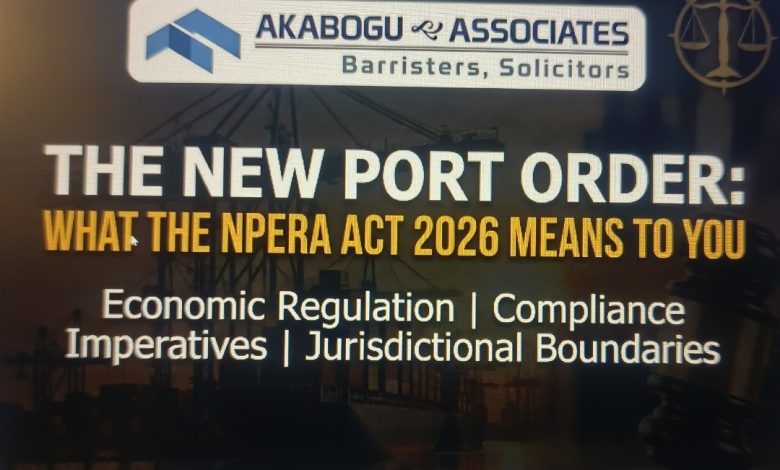
The firm made the call at a webinar on Tuesday, themed: “The New Port Order: What the NPERA Act 2026 Means to You.”


During the virtual summit which had over 200 participants, including terminal operators, shippers, freight forwarders and lawyers, Senior Partner, Akabogu & Associates, Dr. Emeka Akabogu SAN, identified three issues demanding industry attention: the boundaries of the regulated sector; overlapping regulatory responsibilities; and the financial implications of the new framework.

He explained that businesses must assess their position by reference to the services they provide or use, rather than assume that their existing relationship with another regulator determines whether NPERA applies to them.
Participants were cautioned against treating licences or approvals from other agencies as automatically satisfying the Act’s registration requirements.
The panel sessionoderated by Moses Nwogha, looked at how NPERA’s mandate overlaps with those of Nigerian Ports Authority (NPA), Nigerian Maritime Administration and Safety Agency (NIMASA), Nigeria Customs Service (NCS), Council for the Regulation of Freight Forwarding in Nigeria (CRFFN) and the Federal Competition and Consumer Protection Commission (FCCPC).
On financial and contractual exposure, Mr. Victor Onyegbado, a Partner at the firm, examined the implications of the Act’s 1% freight fee, tariff regulation and existing concession arrangements.
The discussion highlighted the need for clarification of the fee’s collection arrangements and for careful assessment of any tension between regulatory tariff requirements and contractual commitments.
Operators were encouraged to document their tariff positions, identify potential conflicts and obtain advice on appropriate filings and reservations to protect their commercial interests.
Panellists Elizabeth Umoh and Arome Adama warned that NPERA approval does not remove the need to comply with wider competition law.
“The practical message is simple: do not wait for an enforcement notice before reviewing your registration status, tariffs, records, and contracts,” Dr. Akabogu said.
Meanwhile, the firm advised a structured review of regulatory status, charging practices, contracts, record-keeping and inspection readiness. It also urged industry associations to consolidate members’ concerns and take part in regulatory consultations.