Listen to story here

Nigeria’s new marine insurance framework is facing an early test as industry stakeholders examine whether the Nigeria Insurance Industry Reform Act 2025 (NIIRA 2025) can deliver stronger cargo protection without creating new costs for businesses already grappling with container detention, port inefficiencies and increasingly complex logistics.
These questions came into focus on Thursday at the Nigeria Marine Insurance Forum 2026 Virtual Summit, organised by Akabogu & Associates, where maritime and insurance experts assessed the commercial implications of the new regime for cargo owners, insurers, shipping companies and multimodal transport operators.



Opening the summit, Senior Partner at Akabogu & Associates, Dr. Emeka Akabogu, SAN, described NIIRA 2025 as a significant turning point for Nigeria’s marine insurance market, with implications extending across the maritime value chain.

He said the reforms require the industry to reconsider how maritime risks are allocated, the capacity of domestic insurers, container insurance structures and Protection and Indemnity (P&I) cover as cargo increasingly moves across multiple transport modes.
“Are we reshaping the sector?” Akabogu asked, while questioning where maritime risk effectively ends – at the port, upon loading onto trucks or at the shipper’s warehouse.
He noted that Nigeria’s charter and freight market was estimated at about $10 billion roughly a decade ago, arguing that the scale of the maritime economy warrants a stronger domestic insurance ecosystem capable of retaining more value within the country.
Container insurance faces a new test
In his presentation, Mr. Victor Onyegbado, Partner at Akabogu & Associates, said NIIRA 2025 presents an opportunity to address longstanding weaknesses in Nigeria’s container insurance regime.
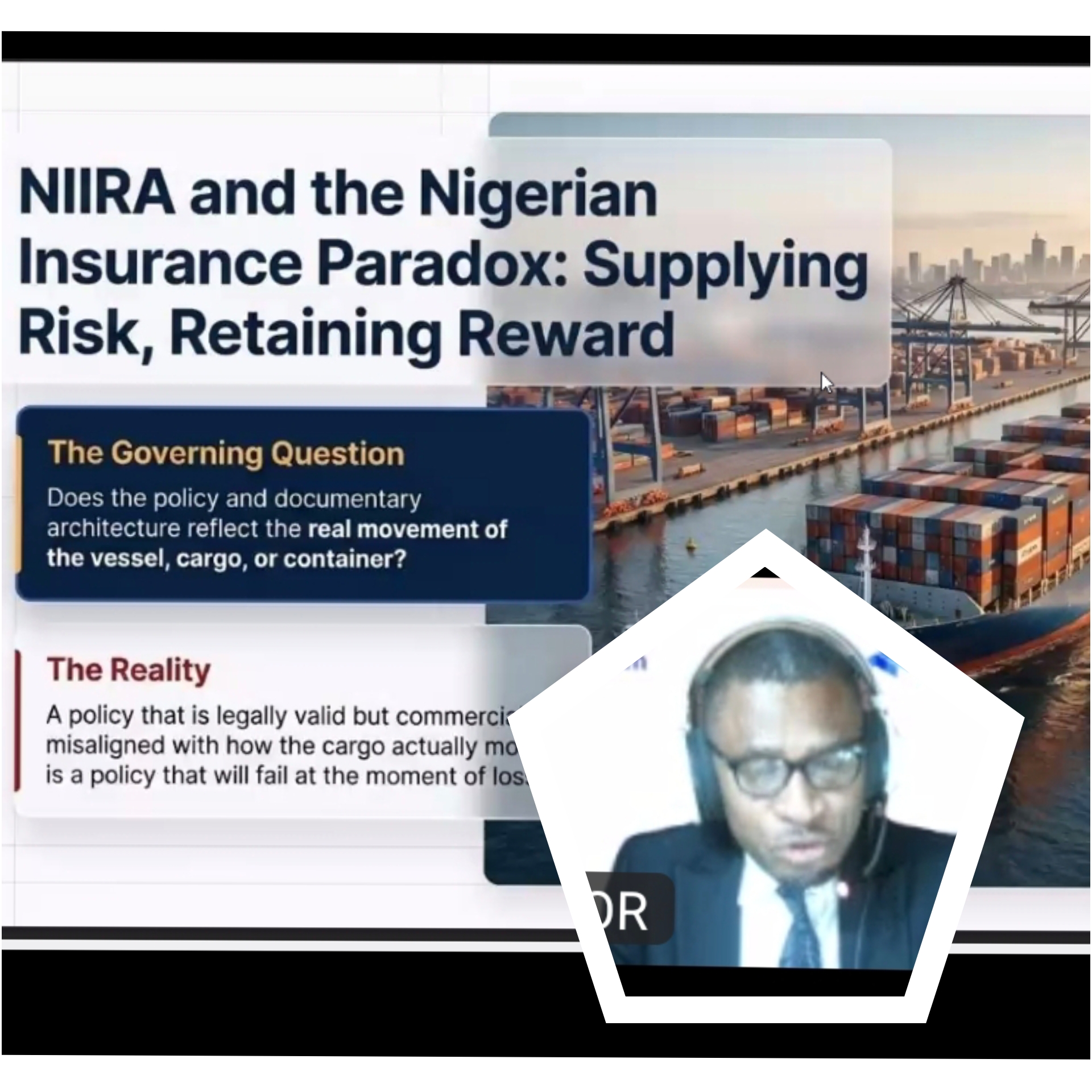
He argued that the traditional focus on shipping risks no longer reflects how modern supply chains operate, given that cargo routinely moves from vessels to terminals, barges, trucks, warehouses and other logistics points.
“Nigeria seems to be focused only on shipping risks, even though insurance cover is expanded to other modes of carriage,” he said.
One of the most significant changes under the new framework is the shift away from container deposit requirements that have traditionally provided shipping lines with financial security for equipment return and damage.
While deposits offered protection to carriers, they also tied up importers’ funds and frequently became a source of commercial disputes.
The move towards insurance-based protection is therefore expected to reduce upfront financial pressure on cargo interests. But participants cautioned that the reform will only deliver value if insurers and shipping companies avoid reproducing the same financial burden through alternative charges.
Container detention remains another concern. Although detention charges are separate from deposits, prolonged delays in returning containers can impose substantial costs on importers, particularly when delays result from congestion, poor infrastructure or other operational bottlenecks.
The discussion highlighted the connection between insurance reform and the efficiency of Nigeria’s logistics infrastructure.
Stakeholders pointed to persistent challenges around empty-container returns, truck turnaround times and congestion along major port corridors. Such bottlenecks can extend cargo dwell times and increase the financial exposure of importers and other supply-chain participants.
This creates a critical policy question about where the responsibility for costs arising from operational failures sit under the emerging insurance regime?
The issue becomes more significant as Nigeria accelerates port digitalisation and infrastructure improvements. Without corresponding improvements in cargo and container logistics, stakeholders warned, regulatory reform alone may not significantly reduce the cost of doing business.
 From legislation to market practice
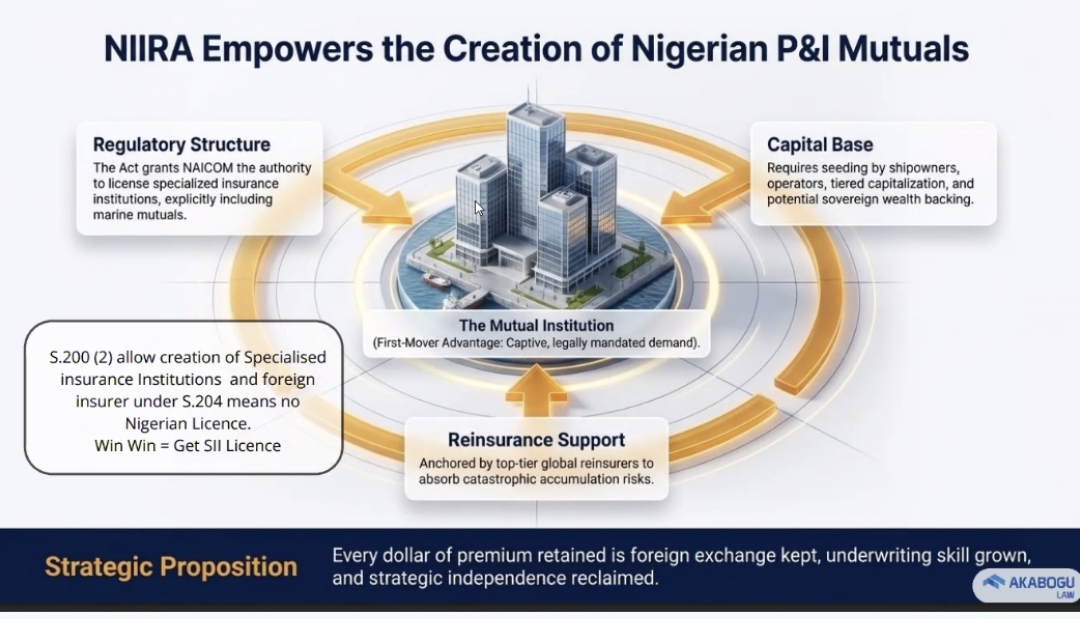
The summit also examined Nigeria’s limited participation in the global Protection and Indemnity (P&I) insurance market.
Despite the scale of the country’s maritime and offshore economy, significant marine insurance premiums have historically been placed offshore. Speakers argued that developing stronger domestic P&I capacity could allow Nigerian insurers to retain more premiums locally while providing products better aligned with domestic operators.
Nigeria’s expanding energy, offshore and maritime sectors could provide the demand required to build that capacity, particularly as industrial companies increasingly depend on maritime logistics without necessarily owning vessels.
Against this backdrop, Akabogu & Associates outlined four broad pillars for moving NIIRA 2025 from legislation to effective market practice.
The first is knowledge of rights created by the law. Port and maritime stakeholders need greater awareness of their statutory rights and obligations, including key provisions contained in Sections 82, 116, 203, 210 and 212.
The second is domestic capacity building. The framework provides opportunities to strengthen professional and institutional capacity, including through training levies under Section 216 and the potential establishment of a Nigerian P&I club under Section 200.
The third is enforcement and litigation. Participants identified the importance of judicial clarification through Federal High Court test cases, particularly on offshore insurance placement under Section 204 and import insurance requirements under Section 82.
The fourth is institutionalisation. This would involve developing standard policy wordings, strengthening digital insurance infrastructure and deepening regional cooperation, including a proposed Nigeria-Ghana marine insurance alliance.
Together, the four pillars point to a broader shift: NIIRA 2025 will require more than regulatory compliance. It will require the creation of institutions, expertise and market mechanisms capable of making the law work in practice.
Enforcement will determine NIIRA’s impact
The forum’s discussions underscored the growing complexity of multimodal cargo movement, where goods can pass through vessels, ports, terminals, trucks, warehouses and other logistics nodes before reaching their final destination.
That evolution raises a fundamental insurance question: does protection follow the cargo throughout its journey, or can contractual and operational boundaries leave businesses exposed at critical transition points?
For cargo owners and freight operators, the answer has direct financial consequences.
For insurers, however, the changing risk landscape presents an opportunity to develop products that reflect the realities of contemporary trade while expanding Nigeria’s domestic underwriting capacity.
The forum’s core message was that legislation alone will not transform Nigeria’s marine insurance market. Enforcement, institutional capacity and active participation by insurers, shipping companies, freight forwarders, regulators and cargo interests will be critical.
For regulators, the immediate challenge is to ensure consistent application of the new framework. For insurers, the opportunity lies in retaining more maritime risk and premium within Nigeria. For businesses, the priority is obtaining predictable and meaningful protection across the supply chain.
The potential economic gains are significant. A stronger domestic marine insurance market could retain more premium value in Nigeria, deepen local expertise, strengthen risk management and provide greater certainty for businesses involved in international trade.
As the Akabogu & Associates summit demonstrated, the real test of NIIRA 2025 will not be the sophistication of the legislation. It will be whether its provisions can survive contact with Nigeria’s ports, supply chains and commercial realities.