Listen to story here
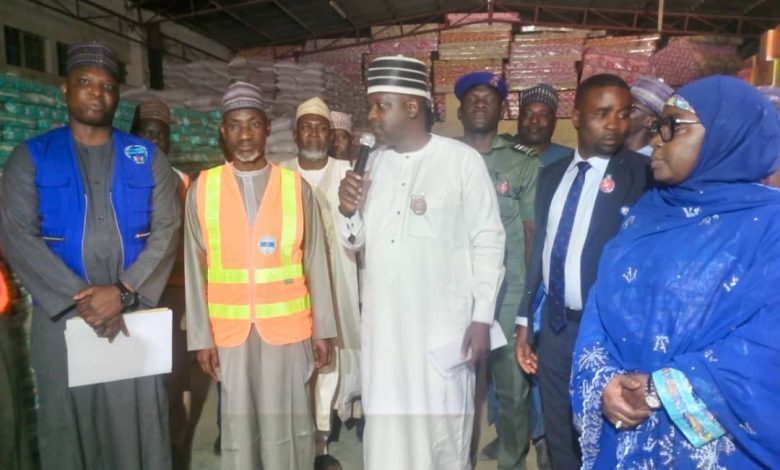
The Aliko Dangote-led Presidential Committee on Flood Relief and Rehabilitation (PCFRR) has delivered emergency relief materials valued at N1billion to the Government of Borno State for onward distribution to persons affected by the 2024 flood in the State.
During the handover ceremony on Wednesday in Maiduguri, the Secretary of the Presidential Committee on Flood Relief and Rehabilitation, Mrs. Hajara Modu, said the committee was committed to supporting flood-affected communities.
Representing the co-chairmen, Alhaji Aliko Dangote and Dr. Olisa Agbakoba, the Secretary said that the distribution of food and non-food items fulfills the pledge made by the committee at the height of the 2024 flood disaster.

In early September 2024, Maiduguri, the capital of Borno State, experienced catastrophic flooding that submerged approximately 70% of the city. This made Borno State the most severely affected region in Nigeria during this year’s flood season. The flooding displaced thousands of residents, destroyed homes, and disrupted essential services, exacerbating the humanitarian challenges already faced in the region.
She said the President of the Dangote Group, Aliko Dangote, had announced the donation of N2billion.
According to her, of the N2 billion donation announced by Dangote, N1 billion is on behalf of the committee for the procurement and supply of relief materials to the flood victims in Borno, and the other N1 billion was donated by the Aliko Dangote Foundation (ADF).
She described Mr. Dangote as very passionate about philanthropy, adding that the committee that was set up in 2012 by the former President Goodluck Jonathan had only a year to work, but through the support of Mr. Dangote it continued to address the flood disasters in the country.
The Governor of Borno State, Professor Babagana Umara Zulum, expressed heartfelt gratitude to the Dangote-led Presidential Committee on Flood Relief and Rehabilitation for its substantial interventions in the state.
The Governor, who was represented by his Deputy Mr. Umar Usman Kadafur said the state government had set up a committee to ensure that relief items reach victims of flooding.
He noted that Alhaji Aliko Dangote, through the committee and his foundation, has consistently provided support in various forms, addressing critical needs in Borno.
Governor Zulum commended Mr. Dangote for his unwavering commitment to humanitarian causes and for contributing significantly to the state’s recovery efforts, particularly during challenging times. He acknowledged that Dangote’s interventions have touched many lives and have been instrumental in mitigating the impact of disasters such as the recent floods.
The Director-General of the National Emergency Management Agency (NEMA) Mrs. Zubaida Umar, commended Mr. Dangote for providing the requisite leadership in humanitarian intervention in the country.
Mrs. Umar, who was represented by the Director of Relief and Rehabilitation, Abdullahi Adamu Usur, said: “Today’s handover of relief materials donated by the PCFRR is a testament to the unwavering commitment of the Federal Government under the able leadership of President Bola Ahmed Tinubu.”
He listed some of the items to include: Beans, Seasoning, Salt, Sugar, Tomato Paste, Vegetable oil, Foam Mattress, Guinea Brocade, Wax Print, Blankets, Mosquito Nets, Nylon Mat, Bathing Soap, Detergent, Children Diapers and Sanitary Pads.
Borno State’s Commissioner for Women and Social Development Zuwaira Gambo thanked the Dangote-led committee for what she described as a huge humanitarian intervention.
NEMA’s Coordinator for Northeast Zonal Office Mr. Sirajo Garba said the agency, in collaboration with other stakeholders, has perfected a transparent modality for the distribution of the relief items from the Dangote-led Committee.