Listen to story here
The Nigerian Shippers’ Council (NSC) has issued a strong warning over worsening delays in cargo clearance at the nation’s seaports, blaming frequent and unauthorised police detention orders for stretching container dwell time to an average of 21 days – one of the highest globally.
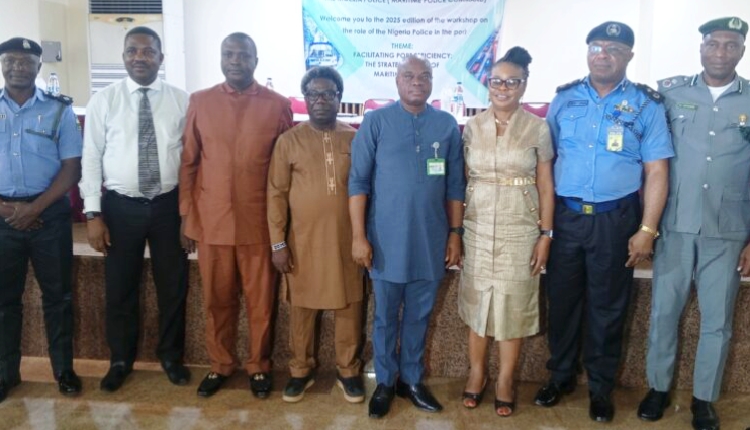
Speaking at a workshop on “Facilitating Port Efficiency: The Strategic Role of Maritime Police,” NSC Executive Secretary, Dr. Pius Akutah, said persistent interference by officers of the Nigeria Police Maritime Command is undermining government efforts to improve efficiency.

Akutah, represented by the Director of Regulatory Services, Margaret Ogbonnah, contrasted Nigeria’s timelines with global benchmarks, noting that similar cargoes are cleared in six hours in Singapore and seven days in Lome, while Nigerian ports remain stuck at 21 days or more.
According to him, indiscriminate police detention orders on already-cleared containers have disrupted port processes, worsened congestion, and triggered excessive demurrage and storage charges for consignees.
“The Nigerian seaports have consistently been ranked among the slowest in cargo clearance worldwide,” he said. “The human factor, especially unapproved law enforcement interference remains the biggest barrier to realising the government’s reforms.”
Akutah said the NSC, as the ports’ economic regulator, has repeatedly engaged the Police High Command to curb these practices.
He recalled that a 2018 directive from the AIG, Maritime Police Command, required all stakeholders to disregard letters not signed by him or authorised officers, yet infractions persist.
He revealed that NSC investigations confirmed that several police formations issue detention orders without the knowledge of the AIG, creating confusion and contradicting approved port procedures.
“Despite progress made from past engagements, some officers still circumvent established processes either deliberately or due to ignorance,” he stated.
The Council reiterated its commitment to collaborating with agencies to reduce dwell time, facilitate trade and ensure seamless cargo evacuation from terminals. It warned that unchecked interference damages Nigeria’s global Ease of Doing Business ranking and discourages port patronage.
Earlier, Assistant Inspector-General of Police, Maritime Police Command, Chinedu Oko—represented by DCP Chukwuemeka Obasi—said the police are restructuring their operations to align with the Marine and Blue Economy reforms.
He said the Command is working to eliminate overlapping enforcement roles, strengthen collaboration with key agencies such as NPA, NIMASA and Customs, and deploy digital tools for surveillance and intelligence under initiatives like the Deep Blue Project.
“These measures are designed to ensure that police activities complement, not complicate, port operations,” he said, acknowledging that overlapping functions and poor operational clarity still pose challenges.
He assured stakeholders that the Maritime Police remain committed to transparency, digitalisation and harmonised port operations.