
Listen to story here
Every day, the global economy depends on millions of tonnes of cargo crossing the world’s oceans. Food, fuel, medicines, manufactured goods and industrial raw materials all arrive at their destinations because seafarers keep international trade moving. Yet, behind every successful voyage is a workforce confronting extraordinary dangers.

The 2026 International Maritime Organization (IMO) Day of the Seafarer theme; “Carrying World Trade. Carrying the Risks,” could hardly be more timely. It recognises the immense sacrifices made by seafarers who continue to navigate rough seas, piracy-prone waters, geopolitical conflicts, mental health challenges and prolonged separation from their families to sustain global commerce.

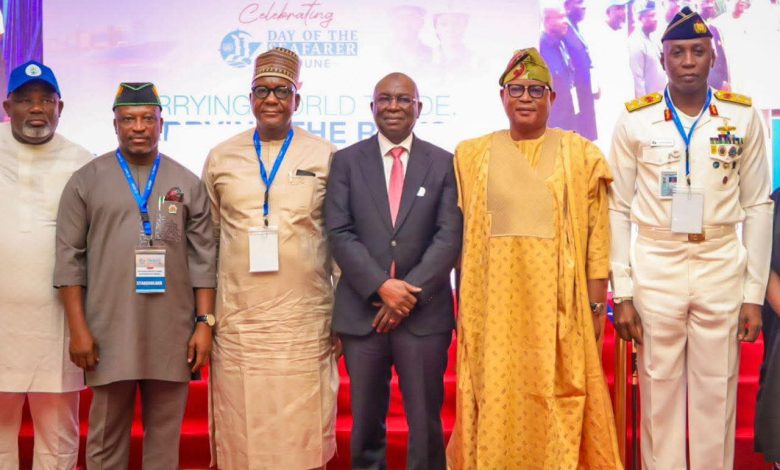
Those realities took centre stage at the 2026 International Day of the Seafarer celebration in Lagos, organised by the Federal Ministry of Marine and Blue Economy in collaboration with the Nigerian Maritime Administration and Safety Agency (NIMASA), where regulators, shipowners, manning agents and seafarers examined the growing risks confronting the profession and the urgent need for stronger protection.
A Small Workforce Carrying Global Trade
Moderating one of the panel sessions, President of Maritime Security Providers Association of Nigeria (MASPAN), Mr. Emmanuel Maiguwa, highlighted the enormous responsibility resting on the shoulders of the world’s seafarers.
According to him, approximately 1.9 million seafarers transport about 14 billion tonnes of cargo annually, meaning that, on average, one seafarer supports the movement of more than 7,300 tonnes of global trade each year.
Despite this indispensable contribution, he noted, seafarers operate under increasingly hazardous conditions. Beyond the traditional dangers of storms and accidents at sea, they also contend with piracy, armed robbery, cyber threats, geopolitical instability and war-risk zones, including tensions arising from the ongoing Israel-Iran-United States conflict.
For Nigerian seafarers, Maiguwa argued, these international challenges are compounded by domestic shortcomings, particularly the slow domestication and implementation of international labour standards designed to safeguard their welfare.
The Maritime Labour Convention: The Seafarers’ Bill of Rights
One of the strongest messages from the event, and aptly captured during the panel session, centred on the need for full implementation of the Maritime Labour Convention, 2006 (MLC, 2006).
Adopted by the International Labour Organization (ILO) and widely regarded as the “Seafarers’ Bill of Rights,” the Convention establishes minimum global standards for decent working and living conditions aboard ships.
It guarantees seafarers fundamental rights, including:
Fair employment agreements
Timely payment of wages
Regulated working hours and adequate periods of rest
Safe and secure working conditions
Decent accommodation and recreational facilities
Nutritious food and clean drinking water
Medical care onboard and ashore
Occupational health and safety protection
Free repatriation at the end of contracts
Financial security in cases of injury, disability, abandonment or death
Access to onboard complaint procedures without fear of retaliation
Social protection and access to welfare facilities in ports
Collectively, these provisions seek to ensure that seafarers are treated with dignity regardless of nationality or flag.
Where Nigeria Still Falls Short
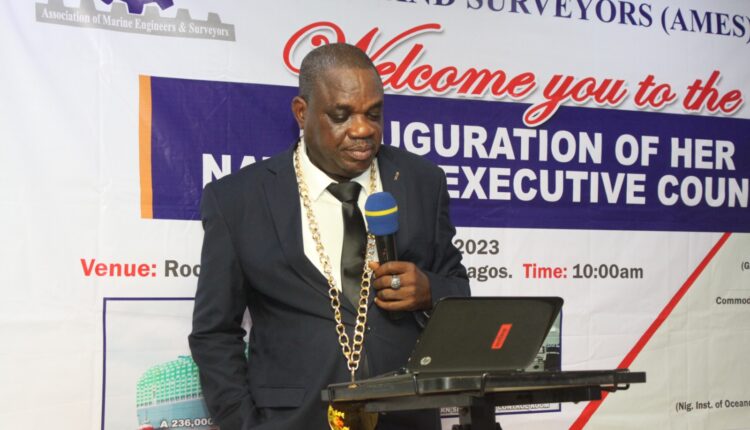
Speaking during the panel discussion, the Head of Nigerian Seafarers Development Programme (NSDP) Unit, NIMASA, Capt. Adebayo Omotosho, observed that many international maritime regulations primarily protect shipowners, vessels and regulatory systems.
According to him, the MLC remains the principal international instrument dedicated specifically to protecting seafarers. However, he lamented that key provisions of the Convention have yet to be fully domesticated and enforced in Nigeria.
Among his recommendations was mandatory internet connectivity aboard vessels to enable seafarers maintain regular communication with their families. He described digital communication as a basic welfare necessity rather than a luxury, particularly given the long periods many seafarers spend away from home.
Omotosho also called for tougher sanctions against shipping companies that fail to comply with MLC standards.
The Gap Between Regulation and Reality
For Esther, a serving Nigerian seafarer, the challenge is not the absence of international regulations. “The framework already exists. What is lacking is effective implementation,” she opined.
She urged maritime administrations to strengthen Flag State oversight and impose sanctions on vessels that fail to comply with international labour standards.
She further called on shipowners to invest more in crew welfare through timely crew changes, warning that prolonged delays at sea significantly affect the mental health and emotional wellbeing of seafarers.
Prompt repatriation at the end of contracts, she added, should never become negotiable.
At the same time, Esther encouraged fellow seafarers to report poor workplace culture, labour violations and non-compliance whenever they occur.
Commercial Pressures Should Not Undermine Welfare
Offering the perspective of manning agencies, the CEO, OceanDeep Marine Services Limited, Mrs. Rollens Macfoy, argued that commercial realities within the shipping industry often work against crew welfare.
She explained that cargo owners are frequently different from shipowners, yet their drive to minimise transportation costs creates financial pressure throughout the supply chain.
Too often, she said, the welfare of seafarers becomes one of the casualties.
Macfoy urged NIMASA to deepen collaboration with the Maritime Workers Union of Nigeria (MWUN) in enforcing the MLC and other relevant ILO labour standards to better protect Nigerian seafarers.
Fear, Blacklisting and Limited Opportunities
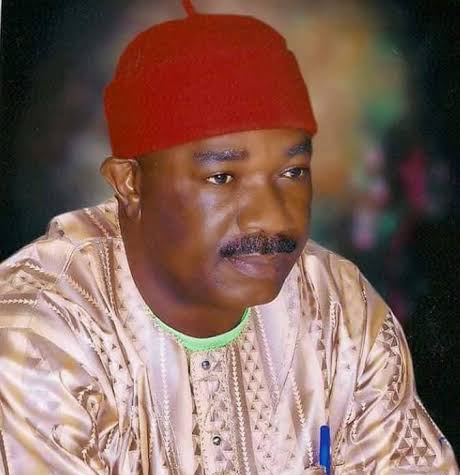
Perhaps the most revealing intervention came from Captain Sunday Umoren, Secretary-General of the Memorandum of Understanding on Port State Control for West and Central African Region (Abuja MoU).
Having served as a regulator, shipmaster and administrator, Umoren acknowledged the competing interests that exist between regulators, shipowners and seafarers.
While full compliance with the MLC would undoubtedly improve working conditions, he argued that Nigeria faces an equally pressing challenge – limited employment opportunities. He recalled that during his seafaring years, he was paid for periods onboard vessels and when onshore. Today, however, most Nigerian seafarers only earn offshore.
He revealed that only a relatively small number of Nigerian seafarers secure employment with reputable organisations such as NLNG Shipping and Marine Services Limited (NSML), where internationally accepted welfare standards are consistently maintained. Many others accept whatever employment is available because opportunities are scarce.
According to Umoren, this imbalance creates an environment in which some seafarers fear reporting labour violations because they risk being informally blacklisted by shipowners and denied future employment.
Such fears weaken regulatory enforcement and undermine confidence in existing complaint mechanisms, especially when ship owners operate like cartels sharing information and experiences including an ‘unruly’ seafarer.
Umoren equally drew the attention of the audience and entire maritime sector to the fiscal challenges facing nation’s ship owners who have to compete with foreign counterparts with access to loans at single-digit interest rates.
From Celebration to Action
The conversations in Lagos reinforced an uncomfortable reality. The world readily acknowledges the contribution of seafarers to international trade, yet many continue to work under conditions that fall short of internationally accepted standards.
The 2026 seafarers’ theme “Carrying World Trade. Carrying the Risks,” is therefore more than a campaign slogan. It is a reminder that the people who sustain global supply chains deserve more than annual recognition. They deserve safe workplaces, decent living conditions, fair contracts, access to healthcare, protection from harassment and intimidation, timely crew changes, secure repatriation and effective legal protection.
For Nigeria, that means accelerating the domestication and enforcement of the Maritime Labour Convention, 2006, strengthening inspections, protecting whistleblowers, holding erring shipowners accountable and expanding quality employment opportunities for indigenous seafarers.
As the Federal Government seeks to unlock the vast potential of the blue economy, the welfare of Nigerian seafarers must move from the margins of policy discussions to the centre of maritime development. After all, those who carry the world’s trade should not be left to carry its risks alone.