Listen to story here
From narcotics and foreign rice to smuggled fuel and counterfeit pharmaceuticals, the Nigeria Customs Service (NCS) is intensifying its assault on a shadow economy thriving along the Ogun-Benin border. But can enforcement alone dismantle a deeply entrenched illicit trade ecosystem?
Along the dusty corridors of Idiroko in Ogun State, Nigeria’s western frontier is becoming the theatre of an increasingly sophisticated battle against smuggling.
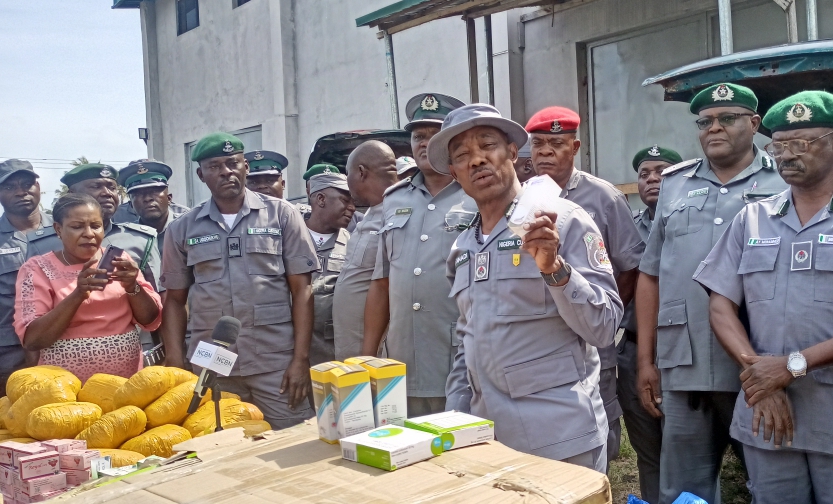
In just 41 days, operatives of the Ogun I Area Command of the Nigeria Customs Service (NCS), under the distinguished leadership of Deputy Comptroller Oladapo Afeni as Acting Controller, intercepted contraband valued at ₦6.77 billion roughly $4.3 million at prevailing exchange rates—underscoring both the scale of illicit cross-border trade and the growing urgency of enforcement efforts.


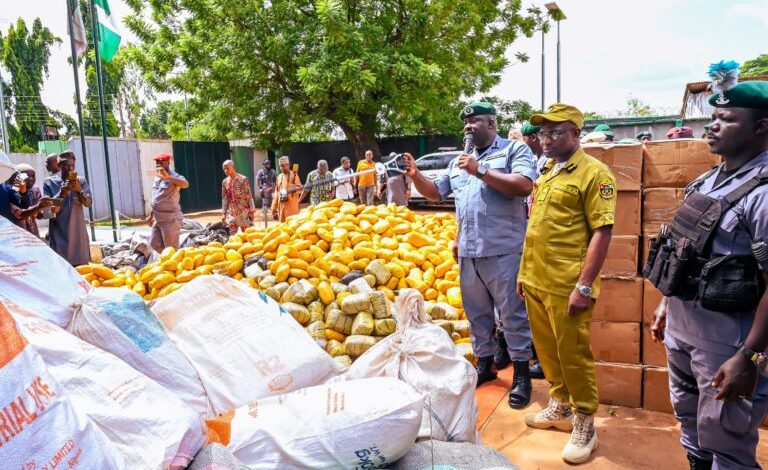
The seizures included over 10,000 parcels of cannabis, thousands of bags of foreign rice, smuggled petroleum products, counterfeit medicines, expired food items, vegetable oil and even trafficked wildlife.

At the centre of the crackdown is Oladapo Afeni, whose leadership at the Ogun I Area Command has coincided with a notable shift toward intelligence-led border enforcement.
For Customs, the seizures are more than operational statistics. They expose an underground economy that has evolved for decades across the porous Nigeria-Benin border, sustained by regional price disparities, weak infrastructure, consumer demand and hundreds of unofficial crossing routes.
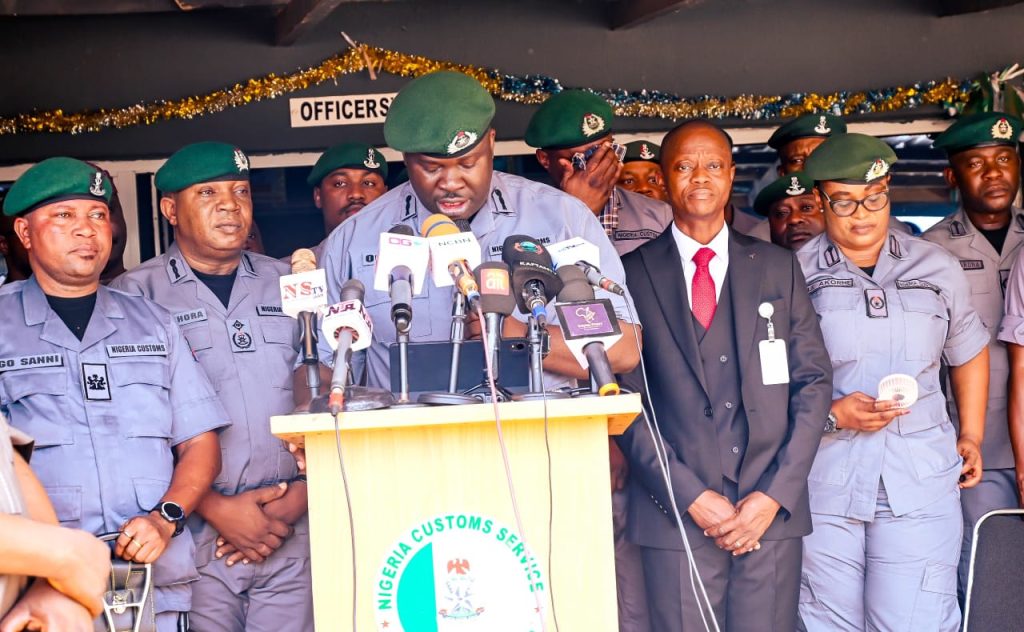
“The seizures are preventive measures,” Afeni said during a briefing in Idiroko. “Without intervention, society would face severe economic and social consequences.”
The Drug Corridor
The biggest seizure was narcotics.
Customs intercepted 10,126 parcels of cannabis indica—popularly called “Ghana Loud”—weighing 4,627 kilograms and valued at more than ₦5 billion in street value.
From January to date, the Command says it has seized over 26,000 parcels of cannabis sativa and indica combined, revealing the scale of narcotics movement through the western corridor.
For security agencies, drug trafficking is no longer viewed as an isolated criminal activity. Analysts increasingly connect narcotics flows to cult violence, armed robbery, kidnapping and broader organised crime networks.
The Idiroko axis has become particularly vulnerable because of its geography. A maze of informal bush paths linking Nigeria and the Republic of Benin allows smugglers to evade conventional checkpoints, making enforcement both physically demanding and strategically complex.
Security experts say the volume of seizures points to increasingly organised transnational syndicates exploiting Nigeria’s porous borders and strong domestic demand.
Yet an uncomfortable question persists: if seizures continue rising, does that indicate enforcement success—or simply reveal the expanding scale of trafficking?
Rice, Fuel and Nigeria’s Parallel Economy
Beyond drugs, foreign rice remains among the most persistent smuggled commodities.
In recent operations, Customs seized 1,759 bags of imported parboiled rice despite restrictions on rice importation through land borders.
Nigeria’s border rice ban was designed to stimulate local agriculture and reduce import dependence. But policy ambition continues to collide with market reality.
While domestic production has expanded, supply shortfalls, logistics gaps and consumer preference for imported brands have sustained a thriving underground rice market.
For many border communities, smuggling is not merely criminal enterprise—it is economics.
Where price differences exist between neighbouring countries, illicit trade often follows.
Fuel tells a similar story.
The Command intercepted 14,550 litres of Premium Motor Spirit (PMS), highlighting how price disparities after subsidy removal have intensified cross-border petrol trafficking.
Petroleum smuggling remains particularly profitable because fuel prices in neighbouring countries are significantly higher, creating arbitrage opportunities for criminal networks.
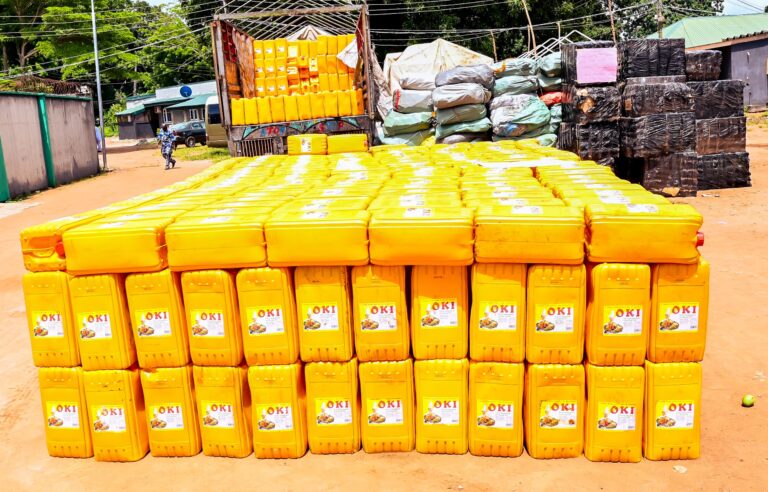
Customs also intercepted 12,271 kegs of smuggled vegetable oil since Afeni assumed office, including a major seizure involving a truck along the Sagamu–Ogere corridor.
For manufacturers, such products represent more than lost revenue.
Smuggled goods bypass tariffs, safety regulations and quality standards, placing domestic producers under pressure in an already volatile economic environment.
“The influx of foreign vegetable oil creates ripple effects across local industry,” Afeni warned.
A Public Health Threat
Among the more troubling seizures were 77 cartons of unregistered Analgin injections, expired seasoning cubes and other unregulated consumables.
Public health experts warn that porous borders continue exposing Nigerians to counterfeit pharmaceuticals and unsafe food products, many of which end up in informal markets where regulatory oversight is weak.
For low-income consumers seeking cheaper alternatives, the risks can be invisible but severe.
In a striking reminder of how border crime continues to evolve, Customs also intercepted six live pangolins, among the world’s most trafficked mammals due to demand for their scales in illegal wildlife markets.
The seizure highlights Nigeria’s growing role as both source and transit route in global environmental crime networks.
Beyond Patrols: Customs Goes Digital
Under the broader reform agenda of Comptroller-General Bashir Adewale Adeniyi, Ogun I Command is increasingly relying on intelligence gathering, geospatial surveillance and digital tracking systems rather than conventional manpower-heavy patrols.
The transition reflects a wider institutional shift inside Customs toward data-driven enforcement.
Analysts say such tools could improve monitoring across difficult terrain and help close operational gaps exploited by smugglers.
But technology alone may not solve the structural drivers of border crime.
Poverty, unemployment, weak border infrastructure and persistent price distortions continue to fuel smuggling demand.
Even as enforcement intensified, Ogun I Command generated ₦125.43 million through baggage assessment and auctioned petroleum products during the review period.
It also facilitated the export of 95 metric tonnes of goods valued at over ₦1 billion Free on Board (FOB), highlighting Customs’ dual role as both trade facilitator and enforcement agency.
Afeni credits collaboration with agencies including the National Drug Law Enforcement Agency, the Department of State Services, the Nigeria Immigration Service and the Police for strengthening operations.
Yet the larger challenge remains unresolved.
Can enforcement dismantle a shadow economy that thrives because of market failures?
Along Idiroko, the battle is no longer merely between Customs officers and smugglers. It is increasingly a contest between state regulation and an adaptive underground economy shaped by demand, geography and survival.
For now, Nigeria’s western border remains one of the country’s most consequential economic frontiers—where every seizure tells a larger story about trade, security and the limits of enforcement in Africa’s biggest economy.