
Listen to story here
Two years after Dr. Abubakar Dantsoho assumed leadership of the Nigerian Ports Authority (NPA), Nigeria’s port debate remains defined by a difficult question: are the country’s seaports finally becoming competitive, or are reforms still trapped between policy promises and operational realities? News Diet examines the evidence.
Since taking office, Dantsoho has pursued a reform agenda built around infrastructure renewal, digitalisation, operational efficiency, revenue growth and stronger stakeholder collaboration. His administration has sought to reposition the NPA from a traditional port landlord and revenue collection agency into a more commercially driven trade facilitation institution. The evidence shows measurable progress.


NPA’s financial performance has strengthened, cargo volumes have increased significantly, ship traffic has expanded and Nigeria’s major ports have recorded improved international operational rankings. However, the daily experience of port users reveals that competitiveness remains a work in progress.

Nigeria’s ports are moving in the right direction, but the journey towards becoming Africa’s preferred maritime gateway remains unfinished.
Stronger Revenue, Stronger Institutional Capacity
One of the clearest achievements of the Dantsoho administration has been improved financial performance. The NPA generated N894.86 billion in revenue in 2024 and N1.19 trillion for 2025, reflecting increased commercial activity, higher cargo volumes and improved institutional efficiency.
The growth represents more than improved revenue collection. It demonstrates a stronger commercial orientation within the Authority, with greater attention to marine services, partnerships, digital processes and alternative revenue opportunities.
However, the ultimate test of revenue growth is whether it translates into improved port services. Higher earnings must eventually reflect in shorter cargo clearance times, improved infrastructure, lower logistics costs and a better experience for importers and exporters. This remains a major challenge.
Cargo Growth and Rising Port Activity
Available operational data indicates that Nigerian ports have recorded significant growth during the period.
Cargo throughput increased from 71.2 million metric tonnes in 2023 to 103.3 million metric tonnes in 2024, representing a 45.1 percent increase. In 2025, throughput rose further to approximately 129.3 million metric tonnes, representing a 24.8 percent year-on-year growth.
Container traffic also improved, increasing from 1.59 million TEUs in 2023 to 1.74 million TEUs in 2024, while vessel calls rose from 3,791 to 4,005 within the same period. These figures indicate stronger port utilisation and growing confidence in Nigeria’s maritime gateways.
Yet, increased volumes alone do not automatically translate into competitiveness. Globally competitive ports are judged not only by cargo handled, but by how quickly, efficiently and affordably cargo moves through the system.
Global Recognition for Apapa and Tin Can Island Ports
One of the strongest endorsements of Nigeria’s recent port performance came from the World Bank and S&P Global Container Port Performance Index.
Tin Can Island Port was ranked the 10th most improved container ports globally, while Apapa Port was ranked 12th most improved between 2020 and 2025.
The recognition confirms that operational improvements are taking place within Nigeria’s port system.
Dantsoho deserves credit for sustaining the reform momentum, improving coordination with terminal operators and supporting initiatives aimed at increasing efficiency.
However, the rankings should be viewed as evidence of progress, not proof that Nigeria has already achieved global competitiveness.

Leading ports compete through speed, predictability and cost efficiency. Nigeria still faces challenges around cargo dwell time, logistics expenses, infrastructure limitations and supply chain coordination.
Digital Transformation Efforts
Digitalisation remains one of the defining pillars of the current administration. NPA has continued supporting the National Single Window (NSW) programme, the Port Community System and other automation initiatives designed to reduce paperwork, increase transparency and limit unnecessary human intervention.
These reforms represent an important shift from manual processes towards a more technology-driven port environment.
However, freight forwarders continue to highlight challenges associated with multiple documentation requirements, overlapping regulatory processes and delays caused by agencies operating within the port ecosystem.
The ambition of achieving a fully integrated paperless port has not yet been fully achieved.
The Infrastructure Question
The greatest test of Dantsoho’s legacy remains infrastructure. While the administration has advanced discussions, financing arrangements and planning for the rehabilitation of ageing port infrastructure, physical reconstruction of major facilities at Apapa and Tin Can Island Ports had yet to fully commence and this distinction is important.
Moving a project from concept to execution is an achievement, but the real impact will be measured when quay walls, cargo handling areas, pavements and supporting infrastructure are visibly modernised.
The competitiveness of Nigerian ports ultimately depends on the successful completion of these projects.
Logistics Challenges Remain
Despite improvements within the NPA, many challenges affecting port competitiveness exist beyond the Authority’s direct control.
The poor condition of access roads linking Port Harcourt Port remains a major obstacle to greater utilisation of Eastern Ports.
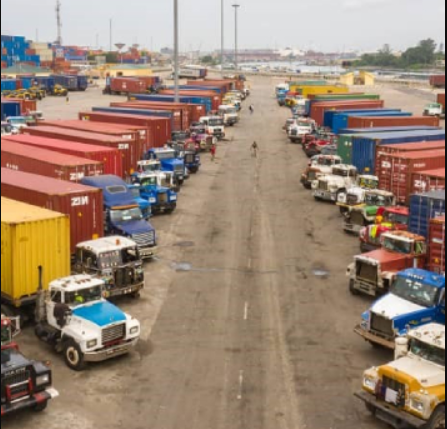
Similarly, congestion is gradually returning around the Tin Can Island Port corridor on the Oshodi–Apapa Expressway, raising concerns that previous gains from the electronic truck call-up system could be undermined.
Lekki Port offers a useful contrast to the national average: while Nigeria’s cargo dwell time is between 18 to 21 days, Lekki averages about 16 days because its systems are fully automated and digitalized. Yet the port still faces structural constraints, especially the lack of rail connectivity and periodic delays linked to Nigeria Customs Service (NCS) physical inspections, showing that even a modern port cannot achieve full efficiency without complementary off-dock infrastructure and seamless regulatory processes.
According to the President of Chartered Institute of Logistics and Transport (CILT) Nigeria, Dr. Boboye Oyeyemi’s appraisal of cargo dwell time within the West and Central African sub-region, Lekki port (16 days) pales in comparison to Port of Cotonou 4 days, Tema port 6 days, Port of Lome 8 days, and Port of Dakar 8 days.
These challenges highlight a harsh reality that port competitiveness depends on the entire logistics ecosystem, including roads, rail connectivity, customs efficiency, terminal operations and regulatory coordination.
The Cost Competitiveness Challenge
Nigeria’s ports continue to face criticism over high logistics costs compared with competing regional gateways such as Tema and Lomé.
Although several charges are outside the direct control of the NPA, the Authority remains central to coordinating improvements across the port value chain.
For Nigeria to compete effectively, stakeholders expect faster cargo processing, reduced delays, predictable charges and a more efficient connection between seaports and inland markets.
Eastern Ports: Untapped Potential
The administration has continued promoting greater utilisation of Onne, Warri, Calabar and Port Harcourt ports.
However, Lagos remains dominant because cargo owners prioritise reliability, infrastructure quality and connectivity.
Unlocking Eastern Ports requires more than advocacy. It requires sustained investment in roads, security, channel maintenance, equipment and commercial incentives that can attract shipping lines.
Final Assessment: Reforms, Not Transformation
After two years, Dr. Abubakar Dantsoho’s tenure presents a mixed; but positive scorecard.
The administration has recorded measurable improvements in revenue generation, cargo growth, vessel activity, digital reforms and Nigeria’s international port reputation.
The improvement of Apapa and Tin Can Island Ports in global performance rankings demonstrates that Nigerian ports can compete when operational reforms are sustained.
However, the harder phase remains ahead.
The true measure of success will be whether port users experience lower logistics costs, shorter cargo dwell time, faster truck turnaround, completed infrastructure projects and a significant reduction in cargo diversion to competing African ports.
Dantsoho’s first two years should therefore be judged as a period of foundation-building rather than completed transformation.
Final Performance Rating: 6.5/10
The NPA under Dantsoho has become more efficient, more commercially focused and more internationally visible. The administration deserves credit for establishing a stronger institutional platform and sustaining measurable operational gains.
However, Nigerian ports have not yet crossed the threshold into full competitiveness. The next two years will determine whether the reforms become a lasting legacy or remain another chapter in Nigeria’s long search for globally competitive ports.