
Listen to story here
Nigeria has taken a decisive step toward maritime decarbonization as the Minister of Marine and Blue Economy, Dr. Adegboyega Oyetola, declared the country’s commitment to achieving net-zero shipping emissions in line with the International Maritime Organization (IMO) 2023 GHG Strategy.

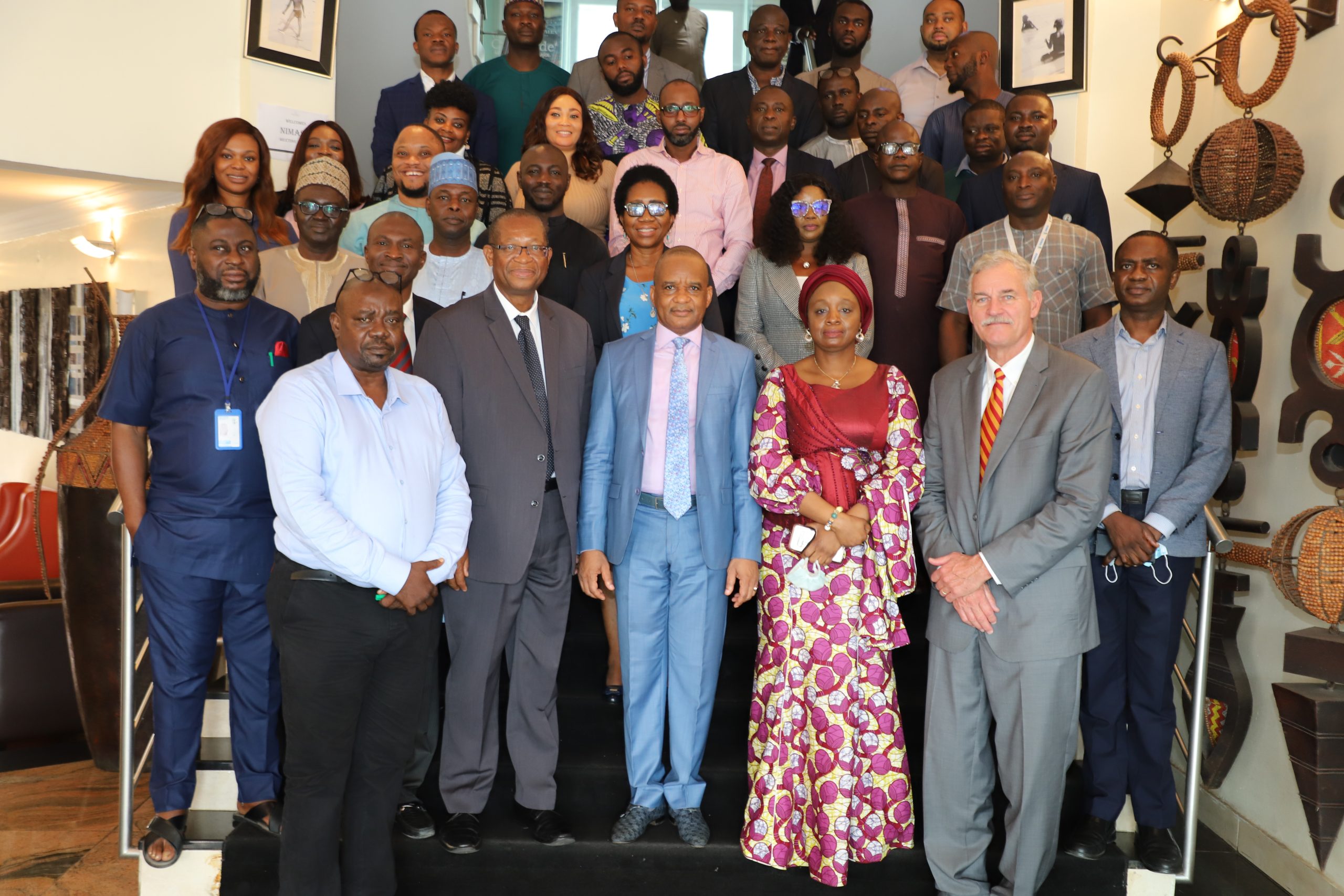
Speaking at the IMO/GreenVoyage2050 National Stakeholder Workshop in Lagos, on Tuesday, Oyetola said the development of a National Maritime Decarbonization Action Plan would align Nigeria with global climate goals while strengthening sector competitiveness.

Backed by the IMO GreenVoyage2050 Project, the Minister who was represented by the Director, Maritime Safety and Security, Federal Ministry of Marine and Blue Economy, John Ogwuche, said the initiative will support emissions reduction in shipping through technical collaboration and stakeholder engagement.
Oyetola urged shipowners, port authorities, oil and gas operators, MDAs and academia to drive collective action, stressing that Nigeria must seize emerging opportunities in the global green maritime transition.

The IMO Green Voyage2050 Programme Manager, Ms. Astrid Dispert, remarked that compliant shipping companies will be rewarded according to the Marine Environment Protection Committee (MEPC 83), while non-compliant shipping companies will be penalised.
Stressing that maritime nations that fail to decarbonize will be left behind, Dispert equally emphasised that Nigerian seafarers must be trained in line with the changes and opportunities emerging with energy transitions that net-zero brings.
Dispert recommended that NIMASA in collaboration with Nigerian maritime stakeholders explores short, medium and long term measures to decarbonize shipping.
“There is a net-zero target which is zero carbon emissions by 2050. The Nigerian government must have a plan to support the industry’s bid for decarbonization,” she added.
The Director General, National Council on Climate Change (NCCC), Dr. Tenioye Majekodunmi, assured the Council’s commitment to supporting Nigeria’s participation in the IMO Green Voyage 2050 programme and to secure a resilient, competitive, and climate-aligned maritime future for Nigeria.
“I commend NIMASA for its leadership, particularly as Nigeria begins participation in the IMO Green Voyage 2050 Programme and formally launches the development of a National Action Plan on maritime decarbonisation.
“The global shipping industry is undergoing structural transformation. With the IMO’s enhanced climate ambition and evolving global trade standards, maritime decarbonisation is no longer optional it is a competitiveness imperative. As a major maritime nation in West Africa, Nigeria must position itself strategically within this transition,” she said.
Earlier, the Director General of Nigerian Maritime Administration and Safety Agency (NIMASA), Dr. Dayo Mobereola, posited that the success of this National Action Plan hinges on the diverse expertise, practical insights, and collaborative spirit from stakeholders .
Mobereola, who was represented by the Executive Director, Operations, NIMASA, Engr. Fatai Taiye Adeyemi, said; “Nigeria’s participation is not just about compliance, it is about safeguarding our environment, protecting public health, and fostering sustainable economic growth. It is about ensuring that Nigeria remains a competitive and responsible player on the global maritime stage.”

Also speaking, the President of African Women in Maritime (WIMA) Nigerian Chapter, Mrs. Theodora Nwaeze, observed that for the IMO Green Voyage 2050 mandate to be inclusive, women and underrepresented groups must be actively engaged in shaping and benefiting from the green transition.
“As we deliberate, we must focus on practical pathways toward cleaner fuels, energy efficiency, green port development, and innovative technologies that will position our industry for a low-carbon future. For Nigeria and the wider African maritime community, this transition presents not only obligations but also opportunities for investment, capacity building, job creation, and inclusive growth.
“I am confident that through collaboration, knowledge sharing, and strong stakeholder engagement, we can advance meaningful solutions that will strengthen our industry while safeguarding our environment for future generations.”
Meanwhile, the Director General of Nigerian Chamber of Shipping (NCS), Mrs. Vivian Chimezie-Azubuike, stressed that Nigeria must prioritise credible data collation, emissions monitoring, and reporting systems, alongside sustained capacity building for regulators, port operators, shipowners, and seafarers.
“There must be collaboration across ministries and agencies including energy, environment, finance, and trade will be critical to ensure policy alignment and infrastructure readiness,” Vivian remarked.
The occasion was graced by several maritime stakeholders including; the Nigerian Navy, Nigerian Midstream and Downstream Petroleum Regulatory Agency (NMDPRA), Women in Maritime Organisations in West and Central Africa (WIMOWCA), Women’s International Shipping and Trading Association (WISTA) Nigeria, Nigerian Ports Authority (NPA), Nigerian Shippers’ Council (NSC), Sea Transport Group, Asiko Energy, among others.