Listen to story here

- As Navy holds Sailing Out Ceremony to honour former CNS
The immediate-past Chief of Naval Staff (CNS), Vice Admiral Awwal Gambo CFR, has described Nigeria’s delisting from piracy prone countries by the International Maritime Bureau (IMB) as his biggest triumph as the CNS.
Gambo, who gave this remark at the Pulling/Sailing Out Ceremony organized by the Nigerian Navy in his honour, emphasised that the feat which occured in 2022 has changed the nation’s maritime security narrative after 27 years.


According to Gambo, Nigerian Navy’s improvement in security, coupled with strategic partnership with other regional navies in the Gulf of Guinea (GoG) led to the drastic reduction in the number of reported incidents of piracy on Nigerian waters.

His words: “The past two and half years have been very eventful and the Nigerian Navy has progressed. I have always believed that story of the Navy is journey and every leader that comes adds value to what he has met on ground. Maritime threats are ever dynamic and transnational in nature. In the last two and half years, Nigeria moved out of the piracy-prone countries in the world. This is a record which hasn’t been achieved for the past 27 years.”
“On illegal oil bunkering, through Operation DAKATAR DA BARAWO the Navy brought this menace to the lowest ebb. The Nigerian Navy also leveraged highly on technology in its operations and this has made it more result-oriented and cost-effective. We don’t need to deploy most of our capital ships in the wild to keep pursuing culprits or maritime offenders because from the comfort of all the operational Commands, the Nigerian Navy can vector any maritime offending ships, platforms or persons such as pirates, sea robbers, among others.”
“This ensures that we are able to promptly arrest and prosecute such offenders through the Suppression of Piracy and Other related Maritime Offences (SPOMO) Act 2019. There was the imprisonment of 12 pirates in July 2021 using the SPOMO Act.”
During his valedictory speech, Gambo commended former President Muhammadu Buhari for the honour bestowed on him to serve as CNS, even as he extended gratitude and goodwill to President Bola Ahmed Tinubu.

He added that under his leadership the Nigerian Navy made significant improvement in operations, logistics, manpower development and personnel welfare.
“We recorded great achievements in anti-crude oll theft, anti-piracy and counterinsurgency operations as well as fleet renewal and massive infrastructural development among others. An appraisal of these efforts explains the successes attained by the Service, with increasing capacity to project force across the Gulf of Guinea in support of our neighbours and international partners. The secrets to these noble achievements remain teamwork, integrity and professionalism.”
“As today is for gratitude and celebration and not an occasion for stocktaking, I would like to sincerely commend and thank the Twenty-Second indigenous CNS, Rear Admiral Emmanuel Ogalla, for this honour done to me within a short period after his assumption of office, despite the enormity of his official and personal engagements as the CNS. I sincerely appreciate this gesture. You can be assured of my prayers, best wishes and support always.”
While thanking all Naval officers and ratings for the tremendous support his received as CNS, he enjoined them to avail the same high standards and cooperation to his successor, Chief of the Naval Staff, Rear Admiral Ogalla, who is described as a capable officer.
“As the 21st indigenous Chief of the Naval Staff, it has been a unique opportunity to lead in the onerous task of delivering on our Navy’s constitutional role. I can say that our Navy is a Service of global repute and standards, which we can be proud of,” Gambo said.

He expressed delight to be leaving a Navy is stronger and better positioned than ever before to discharge its constitutional roles for national security and economic prosperity, stressing that his military career, which commenced with officer cadet training in 1984, has been rewarding eventhough there were seasons of excitement and demanding experiences.
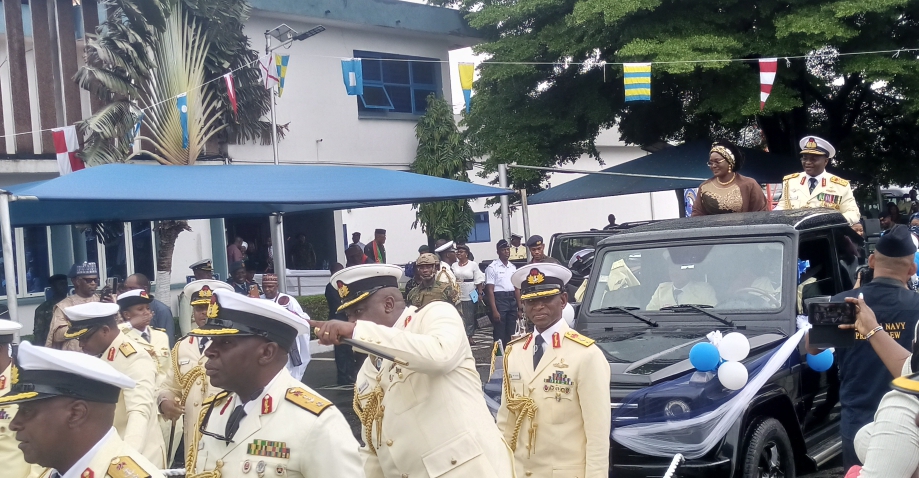
The event also featured a Review of Parade and March Past, as well as Pulling Out and Sailing Out of Vice Admiral Awwal Gambo.