

Listen to story here
The Director General of the Nigerian Ports Economic Regulatory Agency (NPERA), Dr. Akutah Pius, MON, has urged top management to treat the agency’s transition from the Nigerian Shippers’ Council as a fundamental institutional transformation, insisting that the new regulator must be professionally driven, financially sustainable and clear on what it will deliver within its first year.

He gave this charge on Monday at the opening ceremony of a 3-day Strategic Management Brainstorming Programme for Directors, Deputy Directors and Assistant Directors of NPERA.


“This transition, I have said countless times, must not be approached as a mere change of name or a structure of administrative identity. It is a fundamental institutional transformation that requires a new mindset and stronger regulatory responsibilities entrusted by law,” Dr. Akutah said.

He maintained that the immediate priority is to avoid regulatory gaps, protect the interests of the workforce, strengthen stakeholder confidence and establish a clear regulatory framework.
Akutah stressed that the agency must rethink its tools, improve its working culture where necessary and become technologically competent, transparent and sustainable.
The Director General expected the retreat to be frank and solution-driven, examining the opportunities, challenges, risks and institutional adjustments the transition requires.
“Above all, we must define what success will look like in our first one year,” he said.
He identified funding as a major point of difference from the Shippers’ Council era, saying NPERA must be financially sustainable and scalable, generating the revenue to sustain its activities.
He also noted that the agency should already have listed its success stories for the first 100 days, and described the retreat as a chance to make up for lost time and adopt realistic reforms that improve engagement with authorities and stakeholders.
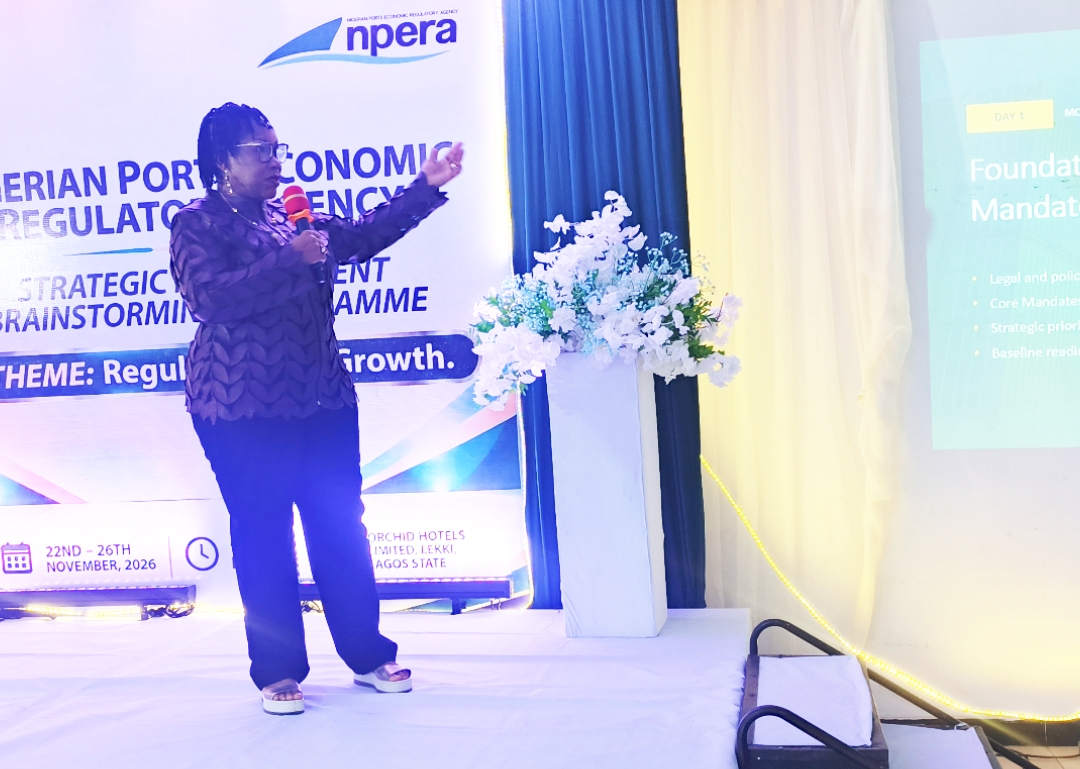
Delivering a presentation at the event, a former Director General of the Nigerian Maritime Administration and Safety Agency (NIMASA), Mrs. Mfon Usoro, charged the Directors to display the knowledge, intelligence and standard of excellence that the industry and the NPERA Act envisage of them.
The session, she said, was meant to ensure that top management fully understands the new structure of the industry, including the functions of the port economic regulator and how they differ from those of an agency like the Nigerian Ports Authority (NPA), which is the landlord of the port.
On his part, the consultant to the programme, Mr. William Azuh, said the 3-day retreat would feature a presentation on the draft NPERA organogram and the fundamental changes that must follow.
“No transition is easy, but with the leadership of Dr. Akutah, I believe we can make it easier. We are here to articulate our views. No view is useless; what matters is how it is presented,” he said.

Mr. Azuh also acknowledged the retired Directors of the Shippers’ Council present at the event, among them; Chief Cajetan Agu, Mr. S. Vongtau, Mr. Tahil Idris, Mrs. Celine Ifeora and Mr. Rotimi Anifowose, commending their past contributions to the Council.
He said participants would leave with key deliverables for three months, six months and one year, captured in three documents: a priority list of the most important targets, an action plan, and a decision and support note.