
Listen to story here
The National Film and Video Censors Board (NFVCB) has secured its first permanent headquarters in its 28-year history, with the building expected to be completed by January 2, 2027, as the agency intensifies efforts to modernise film regulation and respond to the challenges of digital content distribution.
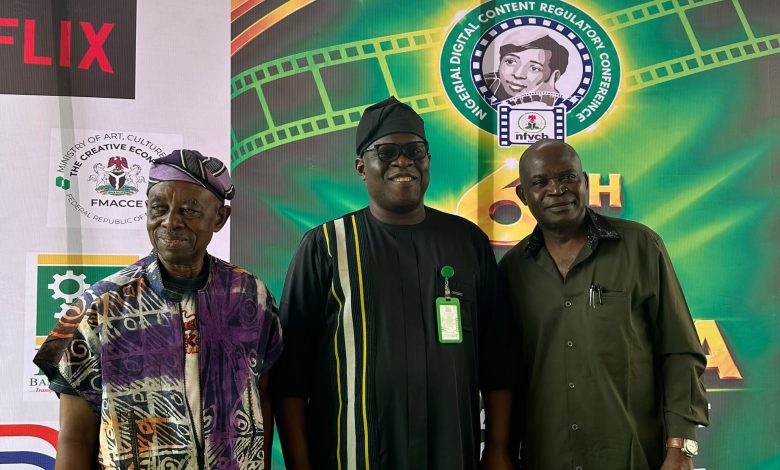
The Executive Director and Chief Executive Officer of the NFVCB, Dr Shaibu Husseini, disclosed this on Wednesday at the opening of the sixth Peace Anyiam-Osigwe Nigeria Digital Content Regulation Conference (PAO-NDCRC) in Lagos.


The 2-day conference, held at the Shell Hall, MUSON Centre, Onikan, brought together filmmakers, actors, producers, content creators and other industry stakeholders to examine the evolving relationship between regulation and creativity in Nigeria’s film industry.

The 2026 edition, themed ‘Film and Content Production in the Digital Era: Balancing Regulation and Innovation’, featured a keynote address by celebrated actor and producer Richard Mofe-Damijo, while filmmaker Kunle Afolayan also spoke at the event. Judith Audu and Fidelis Duker were among the panellists.
Welcoming participants, Husseini said the rapid expansion of social media platforms, digital distribution channels and emerging production technologies had created new opportunities for the creative industry but also raised concerns around intellectual property, ownership, content standards and consumer protection.
Reflecting on his two years and eight months in office, he highlighted efforts to strengthen the board’s institutional capacity and modernise its regulatory operations.
Beyond securing a permanent headquarters, Husseini cited the implementation of the 2024 regulations governing the control of the promotion and glamourisation of tobacco, narcotics and ritual killings as part of the agency’s efforts to improve content standards.
He also disclosed that the board was working towards digitising its operations, including the preservation and transfer of records of films classified since 1994.
Addressing the relationship between regulation and creativity, he stressed the need for collaboration and investor confidence in building a sustainable film industry.
“The future of Nollywood cannot be built by playing safe. It requires collaboration, and it requires that investors must believe in the potential of the industry,” he said.
He urged stakeholders to support a regulatory environment that protects audiences and promotes responsible content without stifling innovation or technological advancement.
In her remarks, the Minister of Art, Culture, Tourism and the Creative Economy, Hannatu Musa Musawa, commended the NFVCB and stakeholders in the film and digital content industry.
She also acknowledged the enduring legacy of the late Peace Anyiam-Osigwe, whose contributions to African cinema continue to inspire conversations about storytelling, creativity and the global relevance of the continent’s film industry.
Delivering the keynote address, Mofe-Damijo called for a regulatory framework that protects audiences and creators while allowing filmmakers sufficient freedom to explore new ideas and technologies.
“The digital revolution is not waiting for us. It is evolving and creating new possibilities every day. We must also be ready to protect our audiences, uphold professional standards, and preserve the integrity of our creative environment,” he said.
He maintained that regulation and innovation should complement rather than undermine each other, arguing that the industry’s future depended on its ability to embrace technological advancement while maintaining accountability.
“The future is not a choice between regulation and innovation. The future belongs to those who understand how to make both work together,” he added.
The actor further highlighted intellectual property protection, fair remuneration for creators and the fight against piracy as critical priorities for an industry seeking to expand its digital footprint and compete internationally.
He urged stakeholders to ensure that the growing global reach of Nigerian films translated into sustainable economic returns for filmmakers and other rights holders.