
Listen to story here
The Nigerian Maritime Administration and Safety Agency (NIMASA) has unveiled a pioneering Public–Private Partnership (PPP) blueprint for maritime decarbonization in Africa, introducing the Nigerian Maritime Continuous Emissions Monitoring System at the UNFCCC COP30 in Belém, Brazil.

The model, developed with researchers from University College London (UCL), positions Nigeria as a continental leader in harnessing digital innovation to accelerate the International Maritime Organization’s (IMO) energy transition goals.


Speaking at NIMASA’s side event, Director of Marine Environment Management, Dr. Oma Ofodile, who represented the Director General, Dr. Dayo Mobereola, said the initiative reflects years of consistent policy direction and technical investment.
She noted that NIMASA has “remained at the forefront of advancing IMO energy transition strategies through digital systems that convert ambition into measurable, verifiable progress.”
NIMASA’s trajectory at recent COP events underscores this momentum. At COP28, the Agency championed the formation of an African coalition on maritime GHG reduction. At COP29, however, it convened expert panels and unveiled progress on Nigeria’s first verifiable maritime emissions inventory, developed with UCL researchers to establish the data foundations for low-carbon shipping.
At COP30, that work matured into a full digital emissions monitoring model—one the Agency says can be adopted across Africa to raise transparency, strengthen compliance, and accelerate regional decarbonization efforts.
Representing the IMO Secretary-General, Mr. Roel Hoeders applauded NIMASA’s leadership, describing the session as “a timely and strategic platform to shape how Africa navigates the challenges and opportunities of the global shipping energy transition.”
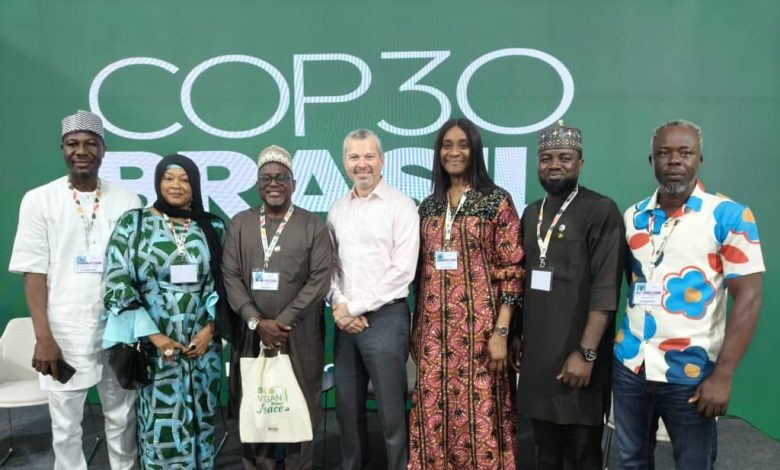
The side event drew experts from IMO, UCL, maritime administrations of Ghana, Kenya and Tanzania, Lagos State Ministries of Planning and Budget, the Federal Ministry of Marine and Blue Economy, the Nigerian Ports Authority (NPA), and others.
COP30 is expected to deliver consensus on indicators for tracking progress under the Global Goal on Adaptation (GGA) of the Paris Agreement—a process designed to streamline 100 candidate indicators aligned with the 11 targets of the 2023 GGA Framework.
NIMASA’s emissions monitoring model is positioned as a practical tool contributing to that global push for clearer, science-based accountability.