

Listen to story here
As Africa edges closer to realizing the promise of a single continental market, policymakers and trade experts in the West and Central African region are converging in Lagos to address one fundamental question: How ready are the continent’s ports, corridors, and shippers for the African Continental Free Trade Area (AfCFTA)?

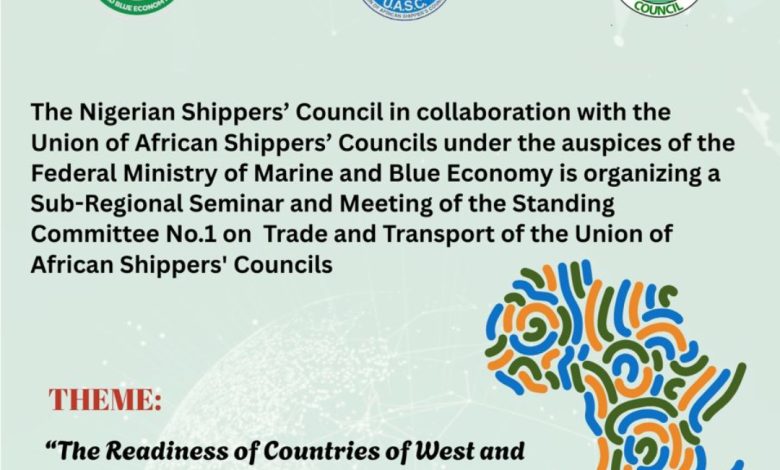
From October 29–30, 2025, the Nigerian Shippers’ Council (NSC), in collaboration with the Union of African Shippers’ Councils (UASC) and under the auspices of the Federal Ministry of Marine and Blue Economy, will host a Sub-Regional Seminar and Meeting of Standing Committee No. 1 on Trade and Transport at the Four Points by Sheraton, Victoria Island, Lagos.

The theme, “The Readiness of Countries of West and Central Africa in the Implementation of the Agreement Establishing the African Continental Free Trade Area – The Role of Shippers’ Councils,” underscores the urgency of aligning regional logistics frameworks with the operational demands of AfCFTA.
Although experts say that while AfCFTA promises to expand intra-African trade by over 50% within a decade, many member states still grapple with structural barriers including; poor transport connectivity, inconsistent customs regimes, and inadequate infrastructure.
Since the success of AfCFTA depends on how efficiently goods can move across borders, it puts Shippers’ Councils at the heart of the conversation – ensuring that logistics, pricing, and policy harmonization work hand-in-hand.
The Lagos meeting aims to harmonize transport and trade policies, enhance port efficiency, and encourage collaboration among West and Central African nations to leverage AfCFTA’s potential.
Meanwhile, Nigeria’s hosting of the event further cements its role as a regional leader in maritime reform and logistics modernization. The country’s focus on multimodal transport infrastructure and its new Marine and Blue Economy Ministry are seen as catalysts for improved trade facilitation.
The Standing Committee No. 1 on Trade and Transport, one of UASC’s key working arms, will use the session to develop policy recommendations that advance the competitiveness of African shippers in the global marketplace.